
Fibrosis After Cosmetic Surgery - Treatment Policy
At Medical Massage Professionals, LLC, we are committed to providing the highest quality care for individuals experiencing post-surgical fibrosis. Our specialized approach is designed to improve your results safely and effectively. Please have a look at our policy carefully before scheduling an evaluation or treatment.
-
At Medical Massage Professionals, LLC, we strive to provide clear and timely communication while ensuring efficiency in managing patient inquiries. To maintain an organized and professional experience, we have the following communication guidelines:
Primary Communication Channels: We use SMS exclusively for clients within the U.S. and WhatsApp as the default communication method for international patients. Other channels (e.g., social media messaging) are not monitored for appointment scheduling or service inquiries.
Response Time: We respond to messages during office hours as promptly as possible. Standard response time is typically within a few hours, but it may vary due to workload, time zone differences, or operational priorities.
Respecting Response Time: Clients are expected to wait for a response via the designated channels before attempting to contact us through other means. Repeated inquiries across multiple platforms can delay responses and disrupt workflow.
Office Hours: Responses will only be provided during official working hours. If a message is sent outside of these hours, it will be addressed on the next business day.
By contacting us, you agree to abide by these communication protocols, ensuring a smooth and respectful interaction for all parties.
-
Fibrosis treatment is a specialized therapy designed to improve scar tissue mobility, reduce post-surgical imperfections, and enhance overall recovery. Due to the complexity of fibrosis and individual healing responses, results vary based on factors such as:
The severity and duration of fibrosis
Individual healing capacity
Consistency in treatment sessions
Proper post-treatment care
Our expertise lies in assessing your condition and developing a customized approach to optimize your results.
-
Before beginning any fibrosis treatment, all patients must undergo an evaluation. This is a crucial step to determine:
Whether you are a suitable candidate for treatment
The estimated number of sessions required
The recommended frequency and post-care guidelines
Quote a treatment plan
Remote & In-Person Evaluations
Remote Evaluations: Conducted via a secure video call. Patients will complete an intake form beforehand and may be asked to submit photos of the affected areas.
In-Person Evaluations: Available at our clinic for those seeking a direct assessment.
All evaluations require a signed Consultation & Authorization Form before the appointment.
-
Fibrosis correction requires consistency for optimal results. Treatment packages are valid for three months from the date of purchase. If a patient fails to maintain consistency, it is assumed they have abandoned treatment. Sessions cannot be resumed after extended breaks, as the progression of fibrosis may render previous work ineffective.
Treatment re-instatement will be exceptionally considered on an individual basis. Reassessment and reinstatement fees are applicable.
-
The estimated number of sessions provided during the evaluation is based on your condition at the time of assessment. However, several factors may alter this estimate:
Additional Treatments: If you undergo other treatments alongside fibrosis correction, some therapies may leave residual effects that could worsen your condition, requiring adjustments to the initial plan.
Undisclosed Treatment History: If previous treatments were not fully disclosed or their impact was misrepresented, they may interfere with progress, potentially increasing the number of sessions required.
Remote vs. In-Person Assessment: A remote evaluation relies on visual observation and patient-reported details. In-person evaluations allow for direct palpation (touch assessment), which may reveal aspects not evident in photos or descriptions. As a result, the treatment estimate given remotely may change upon an in-person assessment.
For the best possible outcome, transparency about past and ongoing treatments is essential.
-
While our treatments are highly effective, we believe in full transparency:
Results vary from patient to patient.
Severe fibrosis may require multiple sessions or may not be fully reversible.
Patience and adherence to the treatment plan are essential for the best possible outcome.
We prioritize honesty and will only recommend treatment if we believe we can provide noticeable improvement.
-
Patients must provide the following before any treatment begins:
A completed intake form with medical history and surgical details
A valid government-issued ID for identity verification
A signed Confidentiality Agreement (if applicable) to protect our proprietary techniques
Medical Massage Professionals, LLC follows strict confidentiality protocols. Any photos taken for progress tracking will be used solely for medical documentation unless explicit permission is granted for educational or marketing purposes.
-
1. Payment Policy:
All payments are non-refundable. They are consideration for reserving time exclusively for you on our calendar, which prevents us from offering it to other clients.2. Prepayment & Confirmation (The 14-Day Rule):
A 30% deposit is required to request and tentatively hold appointment availability.
The remaining balance is due in full at least 14 days before your first scheduled session.
Appointments are not confirmed until the balance is paid in full.
Failure to pay the balance by the 14-day deadline will result in the automatic cancellation of all appointments and the forfeiture of your deposit.
3. Intake Forms (The 5-Day Rule):
All digital intake forms, liability waivers, and agreements must be completed at least 5 business days before your first scheduled session.
Failure to complete all forms by the deadline will result in the automatic cancellation of your appointments. Your deposit will be forfeited as a cancellation fee, as we cannot perform treatment without signed documentation.
4. Rescheduling Fees:
Due to the length of our sessions and advanced scheduling of our international clientele, rescheduling fees apply as follows:More than 72 hours' notice: $100 per session
Less than 72 hours' notice: $150 per session
Rescheduling is subject to availability and not guaranteed.
5. No-Show & Late Policy:
Patients arriving more than 15 minutes late will forfeit their session. The appointment will be marked as complete, and no refund will be issued.
A no-show will result in the forfeiture of the session and the cancellation of all future appointments in the package without refund.
6. Surcharges for Non-Standard Hours:
Our regular business hours are Tuesday through Saturday, 8 am to 4 pm. Sessions must be finished by closing time.
Early A.M. appointment surcharges are:
🕖 Starting at 8 am would be $25/session.
🕖 Starting at 7 am would be $50/session.
🕕 Starting at 6 am would be $75/session.
Late P.M appointments surcharges are :
🕓 Starting at 4 pm for fibrosis or other services would be $25/session
🕕 Starting at 5 pm for fibrosis or other services would be $50/session.
🕖 Starting at 6 pm for fibrosis or other services would be $75/session.
🗓️ Any nonworking day, including (Monday- Sundays and holidays) sessions are $150 above the regular session rate.
Charges are for each session you want to have outside our regular business hours. Subject to availability.
-
For clients who choose the Elevation Gold payment path (40% deposit + 6 installments), the following terms apply in addition to our general policies:
Fixed Payment Schedule
6 installments due on fixed dates (7 days before each scheduled session, or every 3 weeks if sessions are pending)
Payment due dates are independent of session dates and do not move if you reschedule
Late Payment Consequences
Day 1: +$25 fee (we still hold your spot)
Day 2: +$50 fee (we still hold your spot)
Day 3: +$75 fee (we still hold your spot)
Day 4: all remaining appointments are released to other clients
Reinstatement (First Late Payment)
Within 14 days: $150 reinstatement fee + new schedule based on current availability
14–30 days: $250 reinstatement fee + full remaining balance due + new schedule
Bonus sessions are not automatically restored but may be recovered with all remaining payments made on time
Second Late Payment
Day 1: +$50 fee (final warning)
Day 2: all remaining appointments permanently released
Day 3+: full remaining balance due before any future sessions
Bonuses
2 deposit bonus sessions awarded after completing your first 5 core sessions
3 installment bonus sessions awarded only if all 6 payments are made on time
Reinstatement does not automatically restore bonuses
Digital Booking
Online payments incur a 6% platform use fee
Paying online does not schedule your sessions or pause payment obligations
If you cannot find availability before a due date, you must contact us immediately
Full Agreement
The complete Elevation Gold Payment Path Addendum, including all terms and signature lines, is provided separately and must be signed before treatment begins. -
To ensure fairness and efficiency in booking our services, we have the following scheduling and availability guidelines:
Deposit Requirement: A 30% deposit is required to secure your appointment dates. This deposit guarantees your selected time slot, as our availability fluctuates with incoming bookings.
First-Come, First-Served: All appointment slots are allocated on a first-come, first-served basis. We can only guarantee availability once a deposit and confirmed dates are provided.
Commitment to Dates: Clients must provide their preferred appointment dates at the time of booking or shortly thereafter. If no dates are provided, we cannot guarantee availability or honor the offer indefinitely.
Non-Refundable Policy: All payments, including deposits, are non-refundable. Failure to schedule within the designated timeframe will result in forfeiture of the deposit.
Timeframe for Booking: Clients who have paid the deposit have 90 days from the consultation date to schedule and begin treatment. If no appointment is scheduled within this period, the offer will no longer be valid.
Completion of Treatment: For those who pay in full and begin treatment, all sessions must be completed within 90 days from the first appointment.
By making a payment, you acknowledge and agree to these terms.
-
To protect our proprietary methods, we screen potential patients working in healthcare or beauty industries. If a conflict of interest is identified, we reserve the right to decline treatment.
Additionally, we maintain a professional environment and do not tolerate disruptive or aggressive behavior.
-
By engaging with Medical Massage Professionals, LLC and receiving any treatment, you acknowledge and agree to the following:
Understanding of Treatment Limitations: You understand that results vary from person to person. Medical Massage Professionals, LLC does not guarantee specific outcomes, and you acknowledge that treatments are provided based on professional expertise, but individual reactions cannot be predicted.
Non-Disparagement Agreement: You agree not to make, publish, or share any false, misleading, or defamatory statements regarding Medical Massage Professionals, LLC, Marian Sotelo-Paz, or any of its employees, associates, or partners in any format, including but not limited to social media, public forums, blogs, review platforms, and community groups.
Acknowledgment of Informed Decision: You confirm that you have reviewed the available information about the treatments, fully understand the nature of the services, and are participating of your own free will. Dissatisfaction with personal results does not reflect the company’s qualifications or expertise.
Legal Consequences of Defamation: Any violation of this agreement, including defamatory, misleading, or damaging remarks about the company or its personnel, will be considered a breach of contract. In such cases, the company may seek damages of up to $1,000 per incident or publication.
By proceeding with treatment, you confirm your acceptance of these terms.
How do we determine the areas of treatment

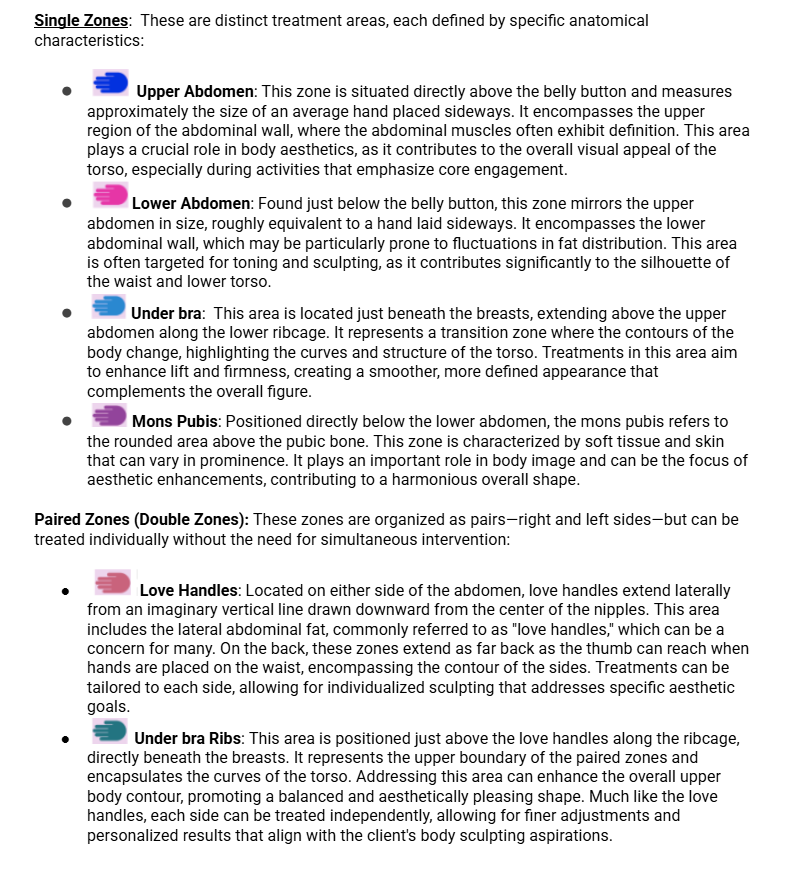
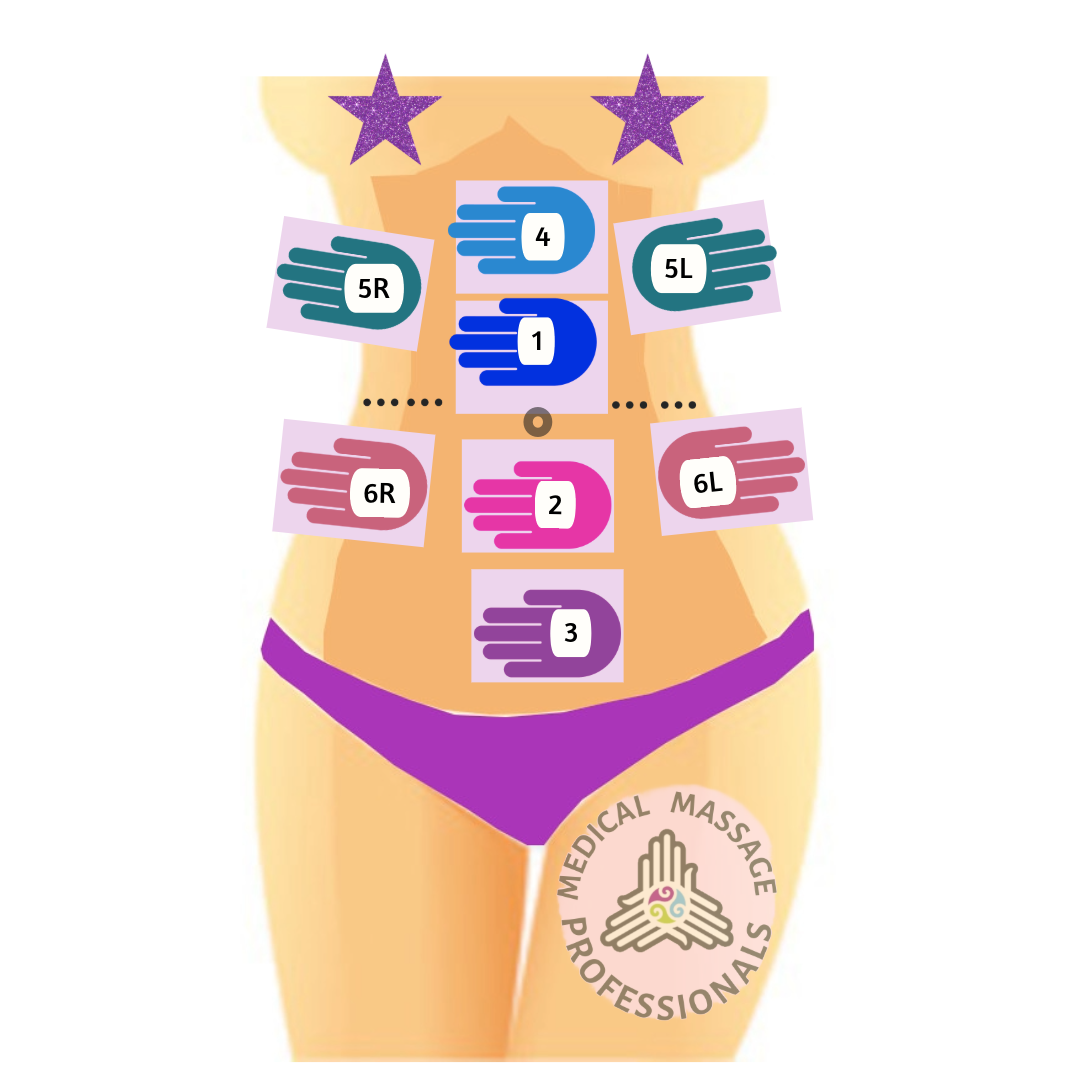
Each treatment zone is roughly the size of an average adult hand, encompassing both the palm and fingers. This open-hand measurement serves as a reliable visual reference, allowing for an intuitive estimation of the size of a single treatment zone. Below, a graphic illustrates the anatomical boundaries that define each zone.
When discussing the human body, it's vital to differentiate between regions, sections, and zones to communicate effectively:
- A “region” represents a broad area, like the torso, back, arms, or legs, each encompassing a variety of sections that define their unique characteristics.
- A “section” refers to a more precise part of a region, such as the upper back or lower thigh, offering a more apparent distinction within the larger region.
- A “zone” is the most specific subdivision, pinpointing the exact area designated for treatment within a section, such as the upper abdomen, lower abdomen, or the mons pubis.
For instance, while the term "midsection" provides a general idea of the central part of the body, it encompasses distinct zones like the lower abdomen, upper abdomen, and mons pubis, each with its unique treatment considerations.
Additionally, the body's symmetry leads to naturally paired zones, such as the left and right love handles. These paired zones can be treated independently, as they may not always show equal treatment effects, allowing for more tailored and effective care.
FIBROSIS AFTER LIPOSUCTION TREATMENT ZONES

1. Single Treatment Zones (One Open Hand-Sized Area)
Upper Abdomen: From the belly button up. [#1 in the diagram]
Lower Abdomen: From the belly button. [#2 in the diagram]
Mons Pubis: Directly above the pubic bone (requires Lower Abdomen treatment).[#3 in the diagram]
Under bra: The area above the upper abdomen, from the sternum to the under-breast fold. [#4 in the diagram]
Sacral Area: The area immediately above the buttocks.[#25 in the diagram]
Lower Back: The area right above the sacral and before the bra line [#26 in the diagram]
Back bra line: Mid-back area at the bra strap level.[#27 in the diagram]
Buffalo Hump: Fat pad at the base of the neck. [#30 in the diagram]
Neck
Chin
Face
2. Paired Zones (Right & Left Exist, But Can Be Treated Individually)
Under bra Ribs (Right & Left): The area bordering the ribs on each side of the breastbone.[#5 in the diagram]
Love Handles (Right & Left): Wrap around the waist from front to back.[#6 in the diagram] it reaches as far back as your thumb if you put your hands on your waist.
Hips (Right & Left): The area below the love handles, connecting to the legs. [#7 in the diagram]
Armpits (Right & Left): Hollow area beneath the junction between the shoulder and the arm. [#8 in the diagram]
Inner Arms (Right & Left): Inner part from the armpit to the elbow. [#9 in the diagram]
Outer Thighs (Right & Left): Outside part from the hip to the knee. [#10 in the diagram]
Inner Thighs (Right & Left): Inner part from the groin to the knee. [#11 in the diagram]
Outer Arms (Right & Left): Outer side from the shoulder to the elbow.[#12 in the diagram]
Shoulders (Right & Left): [#13 in the diagram]
Elbow lines (Right & Left): [#14 in the diagram]
Forearms (Right & Left): [#15 in the diagram]
Upper Front Thighs (Right & Left): [#16 in the diagram]
Lower Front Thighs (Right & Left): [#17 in the diagram]
Knees (Right & Left): Covers the front and slight sides of the knee. [#18 in the diagram]
Calves (Right & Left): Back of the lower leg, below the knee. [#19 in the diagram]
Ankles (Right & Left): Around the ankle bone area. [#20 in the diagram]
Lower Rear Thighs (Right & Left): [#21 in the diagram]
Upper Rear Thighs (Right & Left): [#22 in the diagram]
Panty Line (Right & Left): Along the bikini line.[#23 in the diagram]
Buttocks (Right & Left): Entire buttock area. [#24 in the diagram]
Scapula (Right & Left): Shoulder blade area.[#28 in the diagram]
Trapezius (Right & Left): From the base of the neck to the shoulder. [#29 in the diagram]
Detailed Midsection Zones of Treatment
The torso functions as an interconnected structural unit. While individual zones can be treated independently, fibrosis frequently extends into adjacent tissue planes. For this reason, certain areas are grouped anatomically to ensure complete correction rather than partial improvement.
These groupings are based on tissue continuity and common post-liposuction fibrosis patterns — not on upselling, but on therapeutic necessity.
Core Single Zones
Each zone may be treated independently when fibrosis is clearly confined.
[#1] Upper Abdomen
[#2] Lower Abdomen
[#3] Mons Pubis
[#4] Underbra
Paired Zones (Double Zones)
These exist on both sides of the body. They may be treated independently, but bilateral treatment is often recommended for symmetry and structural balance.
[#5R & #5L] Underbra Ribs
[#6R & #6L] Love Handles
Posterior & Back Zones
[#25] Sacrum
[#26] Lower Back
[#27] Bra Line
Torso Fibrosis Pattern Classification
Fibrosis does not always remain confined to a single spot.
Because the torso functions as a connected structural unit, treatment scope is determined by how far tissue tension extends — not just where it appears.
The following classifications explain how patterns are grouped.
How to Use This Page
This page explains how treatment zones are defined and how fibrosis patterns may be grouped anatomically.
It serves as a general reference.
Your personalized Report of Findings contains the specific number of zones and protocol recommended for your condition.
Zone groupings listed here do not override your individualized treatment plan.
Your personalized Report of Findings specifies your recommended protocol. These classifications are used internally to determine therapeutic scope after assessment. Patients do not self-select a pattern. Your personalized Report of Findings specifies your recommended protocol.
LOCALIZED PATTERN
REGIONAL PATTERN
STRUCTURAL (CIRCUMFERENTIAL) PATTERN
Fibrosis limited to a single anatomical zone without structural pull into surrounding areas.
Used for:
Discrete cords
Post-protocol refinement
Extension into adjacent zones
When fibrosis spreads beyond one zone but does not wrap around the torso, regional treatment is recommended to ensure complete release and prevent residual tension.
Wrap-around involvement
When fibrosis forms a continuous band around the torso, isolated treatment is insufficient.
A clinical framework used to determine the appropriate scope of treatment based on tissue spread and structural continuity
-
ANTERIOR SINGLE ZONES:
[#1] Upper Abdomen
[#2] Lower Abdomen
[#3] Mons Pubis
[#4] Underbra
POSTERIOR OR BACK SINGLE ZONES
[#25] Sacrum
[#26] Lower Back
[#27] Bra Line
-
[#5R & #5L] Underbra Ribs
[#6R & #6L] Love Handles
-
For fibrosis limited to the central abdomen.
Includes:
• Upper Abdomen
• Lower Abdomen -
For mild spread into transition zones.
Includes:
• Upper Abdomen
• Lower Abdomen
• Selected adjacent rib or lateral waist segments -
Includes:
#1 Upper Abdomen
#2 Lower Abdomen
#6R Love Handle
#6L Love Handle -
For continuous front-to-side involvement without back extension.
Includes:
• Upper Abdomen
• Lower Abdomen
• Both Underbra Ribs
• Both Love Handles -
Includes:
#1 Upper Abdomen
#2 Lower Abdomen
#4 Under Bra
#5R/L Under Bra Ribs
#6R/L Love Handles
(All anterior, full-zone involvement) -
For widespread anterior and lateral fibrosis.
Includes:
• Upper Abdomen
• Lower Abdomen
• Under bra
• Mons Pubis
• Both Love Handles
• Both Under bra Ribs
-
Upper structural ring.
Focuses on upper torso involvement.
Includes:
• Upper Abdomen [#1]
• Underbra [#4]
• Both Underbra Ribs [#5R & #5L]
• Bra Line [#27]Used when fibrosis affects rib expansion, upper waist contour, or upper torso mobility.
-
Focuses on lower structural ring or lower torso involvement.
Includes:
• Lower Abdomen [#2]
• Mons Pubis [#3]
• Both Love Handles [#6R & #6L]
• Lower Back [#26]
• Sacrum [#25]Used when fibrosis impacts pelvic mechanics and lower torso contour.
-
Indicated when fibrosis forms a continuous tension pattern across the entire torso.
Includes all 11 zones:
Upper Abdomen [#1], (1)
Lower Abdomen [#2], (1)
Mons Pubis [#3], (1)
Underbra [#4], (1) both
Underbra Ribs [#5R & #5L], (2)
Love Handles [#6R & #6L], (2)
Sacrum [#25], (1)
Lower Back [#26], (1)
Bra Line [#27]. (1)
This approach ensures that a fibrotic cord extending from the hip to the rib is treated in full continuity rather than in segments.
Finding Your Rhythm: How Session Timing Influences Your Healing Journey
Understanding the difference between back-to-back and spaced-out sessions helps you make the best decision for your body and your schedule.
At Medical Massage Professionals, we work with patients from all over the world. We understand that traveling for treatment requires careful planning, and a common question we hear is: "Can I do my sessions back-to-back to make my trip more efficient?"
The answer is yes, we can and do accommodate this request. However, our strong clinical recommendation is to space sessions out. To help you make an informed choice, we want to explain the "why" behind our advice. It all comes down to optimizing your body’s natural healing process for the most effective and stable outcomes.
The Body’s Healing Timeline: What Happens After a Session?
A powerful therapy session is a proactive signal to your body. It encourages change, improves circulation, and helps release tension and metabolic waste. This process initiates a vital healing response, which can include temporary inflammation as the body begins its repair work.
This initial phase is crucial. Your body needs time to:
Process the treatment's input.
Flush out metabolic waste.
Allow initial inflammation to subside.
Begin integrating the changes into new, healthier tissue patterns.
When we give the body this time, we set the stage for more profound and stable progress in the next session.
A Smart Strategy for Our Traveling Patients: The "Phased Approach"
For our patients who travel, we often recommend a strategy that balances efficiency with effectiveness: dividing your treatment into phases.
Instead of trying to do all your sessions in one tightly-packed trip, consider planning two or three shorter trips, each with a focused round of 2-3 sessions.
Why this works so well:
Maximizes Each Session: Within a single trip, you can space your 2-3 sessions with a day of rest in between (e.g., Monday-Wednesday-Friday), giving your body crucial recovery time.
Builds Stable Progress: Each round of sessions builds a solid layer of correction. You then return home, allowing your body to fully integrate these changes over several weeks.
Long-Term Efficiency: When you return for your next phased round, your therapist can build upon a stable foundation, often allowing them to progress more quickly and effectively than if the sessions were all done consecutively on inflamed tissue.
This phased approach is not just for travelers; it's a strategic model that anyone can benefit from for achieving lasting, high-quality results.
In Summary: Your Journey, Your Choice
For Optimal, Cumulative Results: Spaced-Out Sessions are the gold standard.
For a Single Intensive Trip: Back-to-Back Sessions can be accommodated, with the understanding that the therapeutic focus will adapt to your body's immediate state.
For the Best of Both Worlds: Consider the Phased Approach—multiple shorter trips with spaced-out sessions in each—for a strategy that is both travel-friendly and clinically ideal.
Our commitment is to provide you with the best possible care and the information you need to make the right decision for your health and your life. We’re here to talk about these options with you and create a treatment plan that aligns with your goals.
Contact us today to discuss which session rhythm is right for you.
Medical Massage Professionals is dedicated to providing expert, personalized care to help you achieve stable and lasting wellness.
Spaced-Out Sessions: The Gold Standard for Cumulative Progress
The Analogy: Building a Strong Foundation
Think of your treatment plan like building a stone wall. Each session is a new layer of stones. After placing a layer, let the mortar set and cure before adding the next layer. This creates a structure that is strong, aligned, and built to last. Stacking layers too quickly results in a less stable wall.
How This Applies to You:
When you return for a session after a few days of recovery, your therapist works with tissue that has integrated the changes from the previous visit. The area is calmer and more receptive, allowing your therapist to build effectively on the established progress. This layered approach is the most effective way to achieve cumulative, stable results.
Back-to-Back Sessions: A Different Therapeutic Approach
The Analogy: Caring for a Sunburn
Imagine you have a sunburn. The smartest thing to do is to get out of the sun and let your skin begin healing. If you were to go right back into the intense sun the next day, you would compound the stress on your skin, potentially delaying the overall healing process.
How This Applies to You:
In a back-to-back session schedule, the second session begins before your body has fully recovered from the first. The area is often still tender and congested. While this is absolutely possible, it requires a different therapeutic strategy.
Your therapist must adjust their techniques and pressure to avoid overstressing the tissues. Consequently, the focus of the second session often shifts towards calming the initial response and ensuring comfort, which means less time can be spent on making new, deeper corrective progress. The overall trajectory toward your goals remains the same, but the path is different and often slightly less efficient.